

Tail losses you can reproduce. Same seed, same run.
The board asks what the tail costs, and gets one number nobody can reproduce. In HONESTAS every tail-loss and stress run is made on a frozen snapshot of the book, with its seed recorded. Run it again next year and you get the same answer, to the cent. Scenarios are changes laid on that snapshot, and every run is sealed into the record your board pack and ORSA rely on.
- Snapshot
- Book at 30 Sep, frozen
- Seed
- 4471 2093 1186
- Years
- 10,000 simulated
- Models
- Storm 2026.2 · repair costs v3
| Replay | 14 Oct | 21 Oct |
|---|---|---|
| Simulated years | 10,000 | 10,000 |
| 1 in 200, net | EUR 96.1m | EUR 96.1m |
| Fingerprint | 7c2e 91a0 | 7c2e 91a0 |
The result can be argued with. The run cannot.
A stress result is only as good as your ability to run it again and get the same answer. HONESTAS makes that the rule.
Freeze
The book is frozen as a snapshot: policies, exposure, reinsurance and the model versions. The snapshot never changes.
Seed
Every simulated run starts from a recorded seed, so the same snapshot and seed always give the same simulated years.
Run
Thousands of simulated years, on the models you choose, on our EU cloud or in your data centre.
Replay
Run it again at any time. If the result does not match its fingerprint, the run is refused and the mismatch recorded.
One snapshot. Many changes laid on it.
A scenario is a change to the snapshot, never a copy of the book. Stronger winds, a storm track further south, dearer repairs or a higher treaty retention: each one moves one thing, and each one can be taken off again.
- Each change named, versioned and owned
- Changes stacked to build a combined scenario
- The difference from the base shown, scenario by scenario
| Scenario | 1 in 200, net | Change |
|---|---|---|
| Base | EUR 96.1m | |
| Wind speeds up 15% | EUR 131.8m | +37% |
| Storm track 40 km south | EUR 74.5m | −22% |
| Repair costs up 20% | EUR 109.3m | +14% |
| Treaty retention EUR 25m | EUR 104.0m | +8% |
Every simulated storm's wind field scaled by 1.15. Nothing else moves: the same policies, the same treaty, the same seed.
Each scenario is a change laid on the snapshot. Take it off and you are back at the base, exactly.
Draw the storm. Run the book against it.
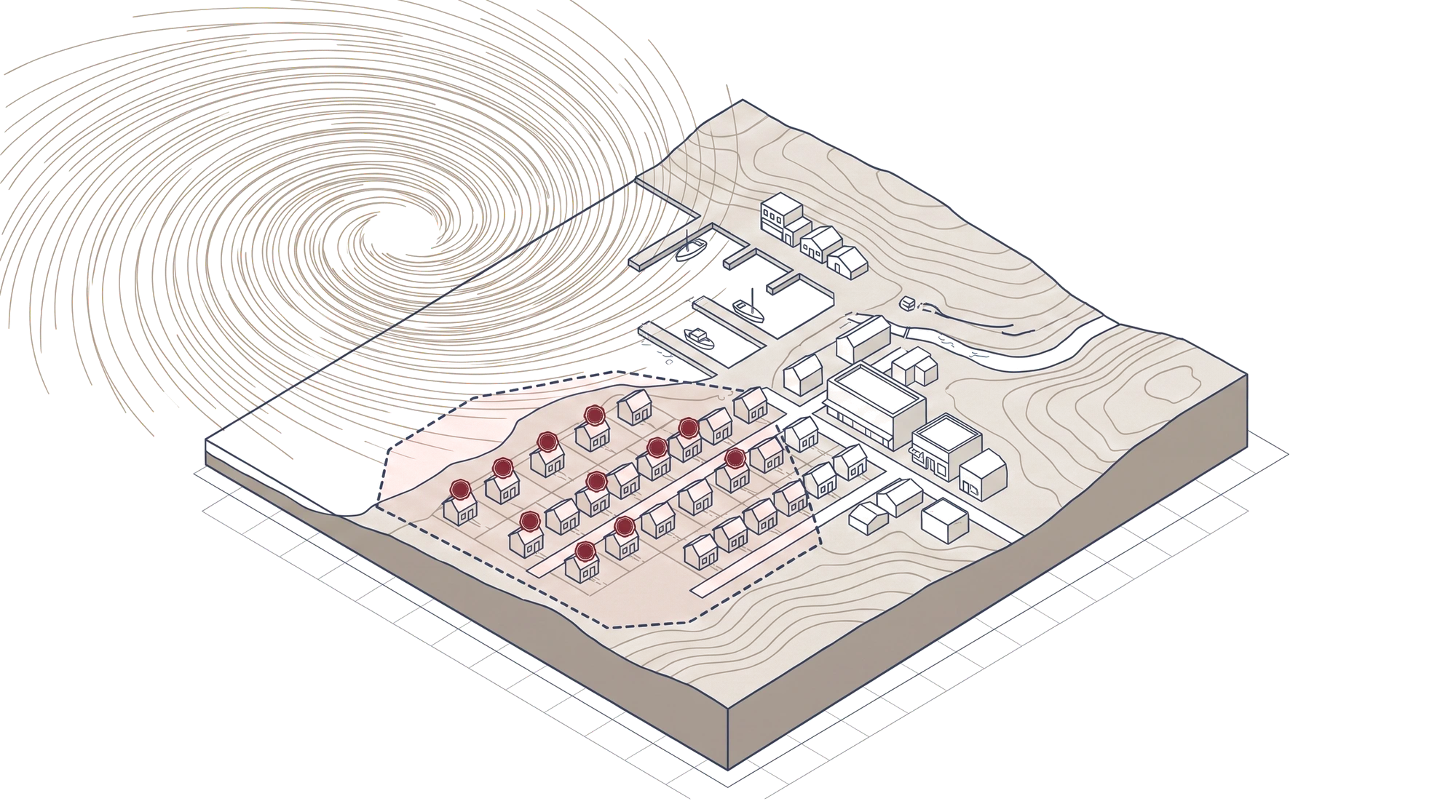
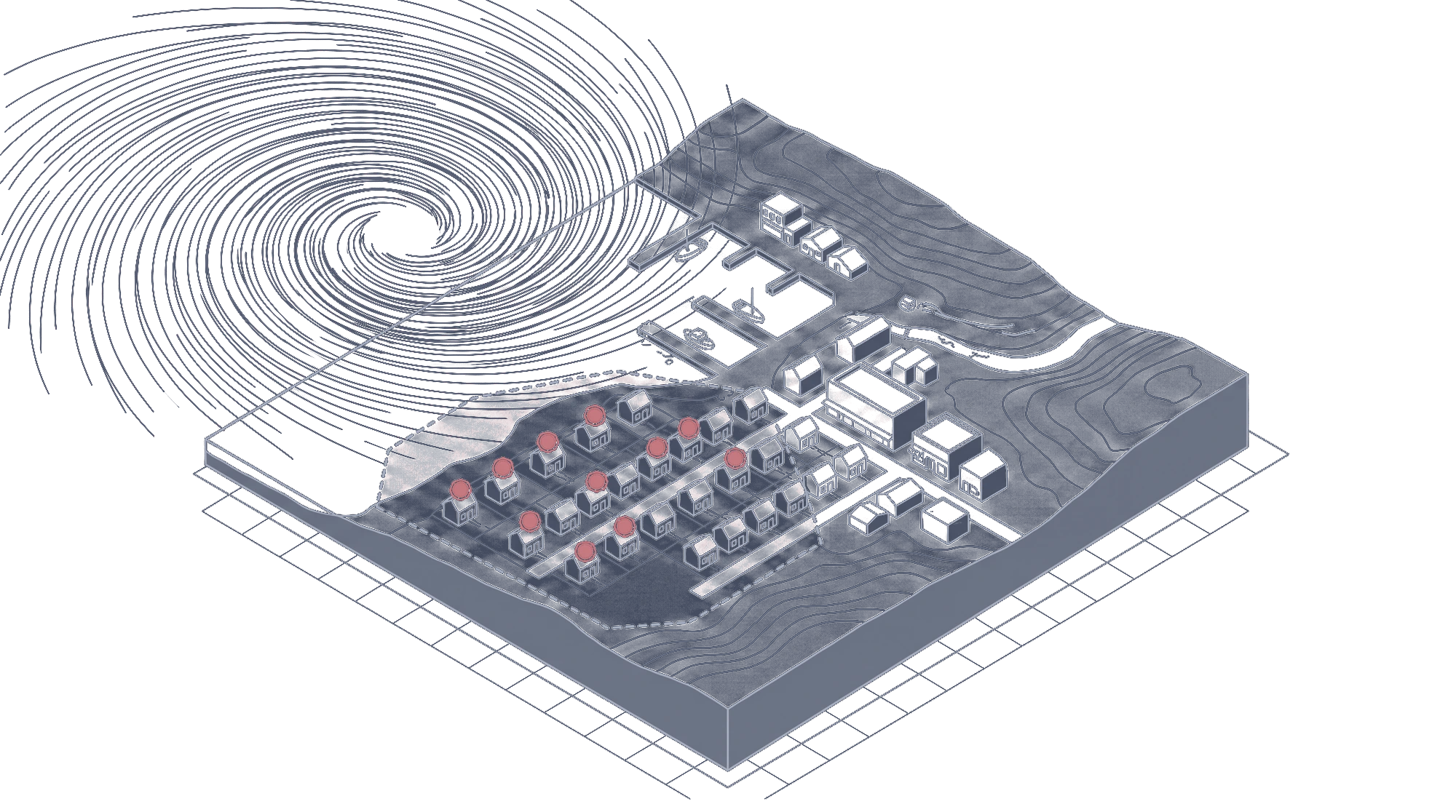
The map holds every insured risk on real terrain, with live hazard feeds. A footprint drawn on it, or a past event replayed on it, becomes a scenario you can run.
Sealed, then used. In the ORSA and the board pack.
A finished run is sealed like any decision: the snapshot, the seed, the scenarios, the models, the result and the person who reviewed it. The figures in the board pack and the ORSA link back to the sealed run they came from.
- Every figure in the pack traced to its run
- A reinsurance decision can cite the run it rested on
- Next year's run is compared with this one, like for like
Sealed run · SR-2611SampleReproducible is the claim. The result is still a model.
What a sealed run shows
- Exactly which book, models, seed and scenarios produced a figure
- That the figure can be produced again, to the cent
- Who reviewed it, and where it was used
- How it compares with last year's run
What it does not show
- That the hazard model is right about the next storm
- That a back-test on past events will hold for future ones
- That the exposure data was complete when the book was frozen
Stress results a supervisor can re-run.
- Solvency II Article 45Directive 2009/138/EC, own risk and solvency assessmentInsurers assess their own solvency needs against their risk profile. Sealed runs show how each figure was reached.
- Solvency II Article 124Directive 2009/138/EC, validation standardsInternal models are tested for stability and sensitivity to key assumptions. Scenarios on a fixed snapshot show that sensitivity, run for run.
- EIOPA Opinion on AIAI governance and risk management, 6 August 2025Documentation and reproducibility for AI and models used in insurers' decisions.
Not legal advice. Certification and legal opinions stay between you and your advisers.
What people ask.
Do we have to use your catastrophe model?
No. HONESTAS runs your own models, or the ones you licence, on the frozen snapshot. What it adds is the snapshot, the seed, the scenarios and the sealed record of each run.
What is frozen in a snapshot?
The policies in force, their exposure, the reinsurance programme, and the versions of every model and table used. A snapshot is never edited. A new one gets a new name.
How do we replay a run from last year?
Open the sealed run and press replay. The same snapshot and seed produce the same simulated years and the same result, and the fingerprint is checked.
Can a scenario come from a real event?
Yes. A past storm or flood can be replayed on today's book from the map, or a footprint drawn by hand. Either becomes a named change on the snapshot.
Where does the computing happen?
On our EU cloud or in your own data centre, whichever you chose for HONESTAS. Large runs are queued and counted against a budget you set.
Go deeper
Run last year's storm on this year's book.
Bring a past event and a recent snapshot of your book. We will run it, lay two scenarios on it and show you the sealed result replay to the same figure.