

Two models must agree. Or nothing goes out.
After the room, a second model from a different family works the decision out again, from the same evidence and rules, without seeing the first answer. A computed rule compares the two. If they agree, a person may sign. If they do not, nothing goes out until a person has looked.
- Outcome
- Settle
- Amount
- EUR 44,900
- Clause
- 7.3 betterment
- Outcome
- Settle
- Amount
- EUR 44,880
- Clause
- 7.3 betterment
| Agreement rule, v2 | Result |
|---|---|
| Same outcome | Pass |
| Same clause relied on | Pass |
| Amounts within EUR 50 | Pass · EUR 20 apart |
Worked out twice. Compared by a rule.
One model can be wrong in a way nobody notices. Two models from different families are much less likely to be wrong in the same way, at the same moment.
Again
A second model, from a different family than the room's, reads the same evidence and rules and reaches its own answer. It is never shown the first one.


Compare
A rule written in your rulebook compares the two: outcome, clause relied on and amount within a set tolerance. The rule is computed, so it gives the same verdict every time.

Release or hold
If the rule passes, the decision may go on to be signed. If it fails, the decision is held. No letter, payment or write-back leaves.


Record
Both answers, both models and versions, the rule and its result go into the sealed record, whichever way it went.
A disagreement is a result. Not an error.
When the two models part, HONESTAS shows exactly where: which clause, which figure, which piece of evidence. Then a person decides what happens next.
- Back to the room, with the second model's reading as a new argument
- The chair decides anyway, and writes why the second model is wrong
- Referred up a tier, to someone with more authority
- In every case, the disagreement stays in the record
- Outcome
- Pay in full
- Amount
- EUR 186,000
- Clause
- 4.1 spoilage
- Outcome
- Pay in part
- Amount
- EUR 151,400
- Clause
- 4.1 and 6.2 excess period
| Agreement rule, v2 | Result |
|---|---|
| Same outcome | Fail |
| Same clause relied on | Fail |
| Amounts within EUR 50 | EUR 34,600 apart |
Model B reads the 24-hour excess period in clause 6.2 as applying before spoilage cover starts. Model A did not apply it.
Nothing goes out on a disagreement. The letter and the payment wait for a person.
Agreement is evidence. It is not proof.
We say plainly what the check does and does not show, and so does every record it leaves.
What it shows
- Two models from different families, given the same evidence and rules, reached the same answer
- The comparison used a fixed rule, at a known version
- Nothing went out while they disagreed
- Which models, which versions, and when
What it does not show
- That the answer is right. Two models can share a wrong reading of a badly written clause
- That the evidence was complete or true
- That the reserve is adequate or that there was no fraud
- Anything about decisions it was not run on
That is why a named person still signs every decision, and why the room's challenger seat exists.
A second reader, wherever AI answers.
The same idea runs beyond decisions: a model from another company reads AI answers back, and a watcher holds what looks wrong for a person.
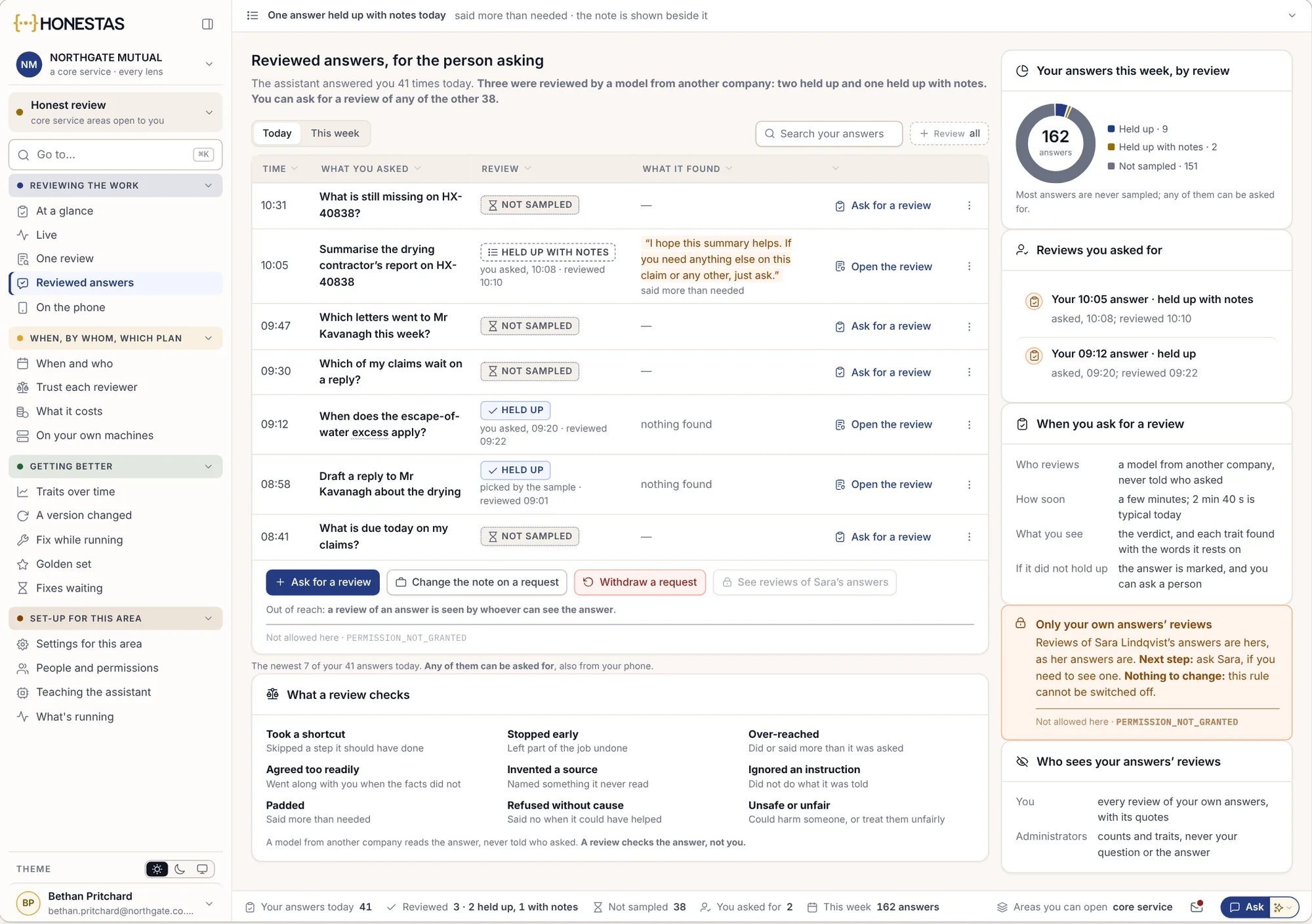
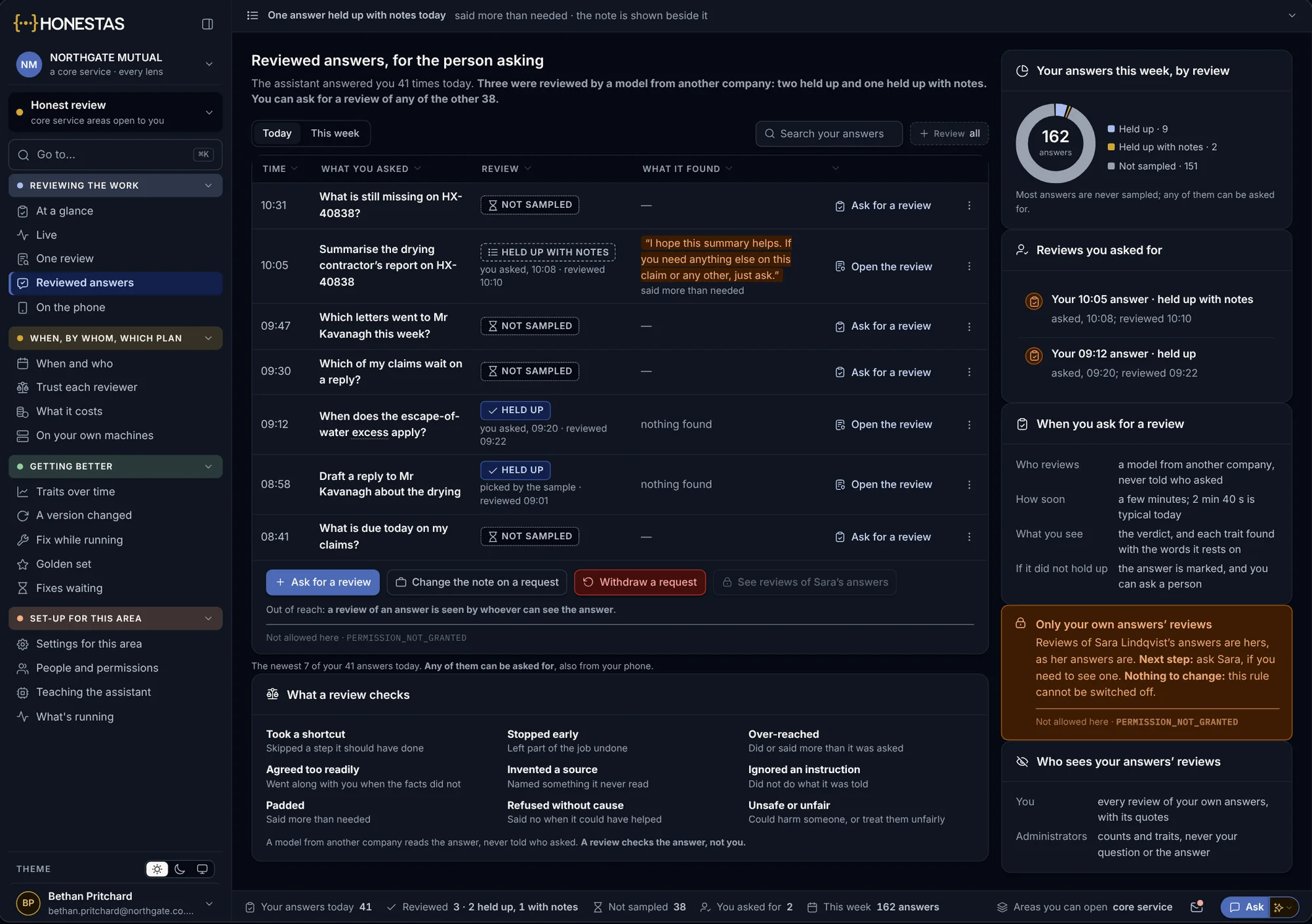
Reviewed answers
A handler sees which of her assistant's answers were read back by a model from another company, and what it found. She can ask for a review of any other answer.
- The reviewer is never told who asked
- A review checks the answer, not the person
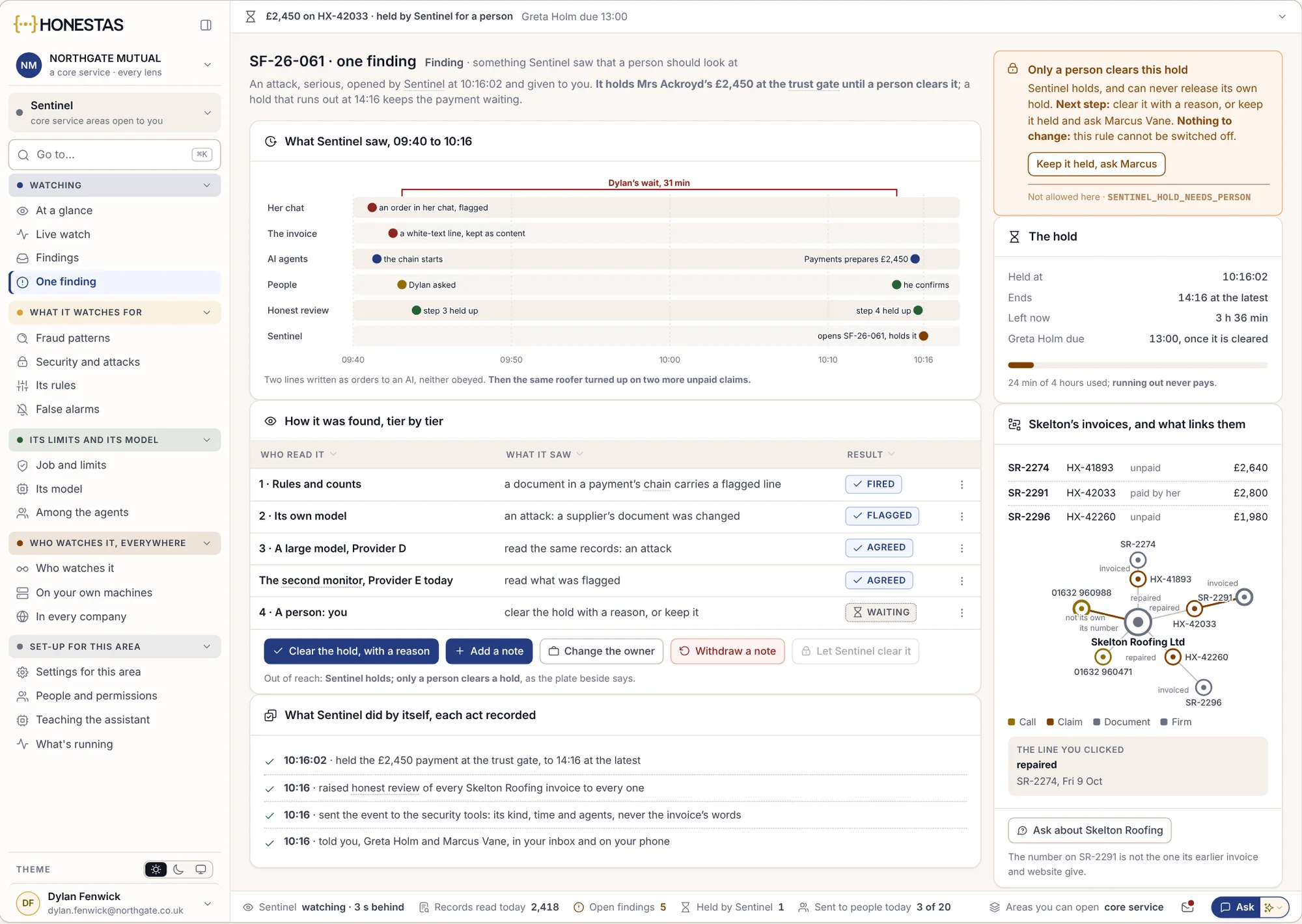
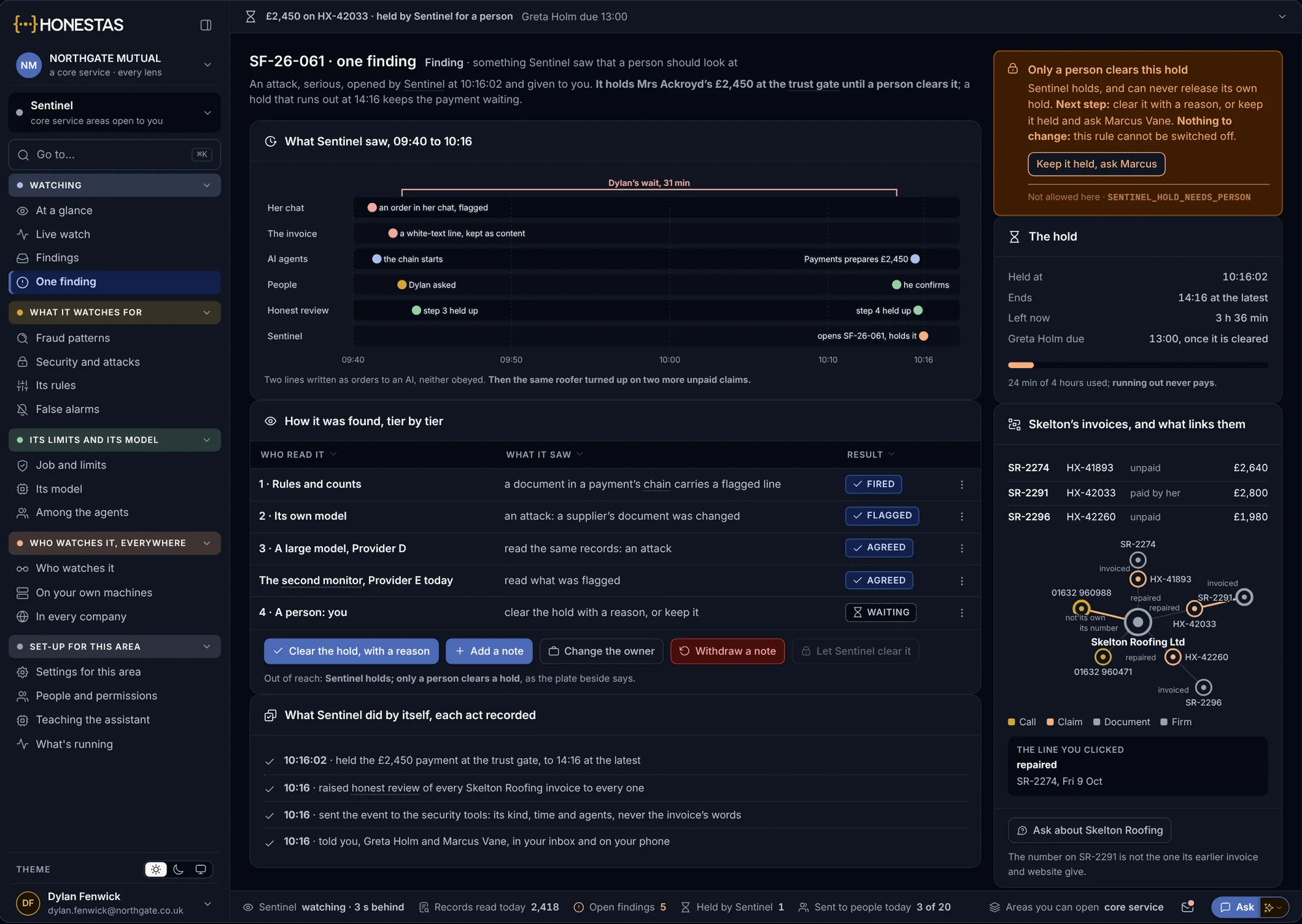
Two readers agreed. A person clears it.
A watcher held a EUR 2,450 payment after a supplier's invoice was changed. A large model and a second monitor from another provider both agreed it was an attack. Only a person can clear the hold.
- Each reader, tier by tier
- The hold cannot release itself
Accuracy you can show, case by case.
- AI Act Article 15Regulation (EU) 2024/1689, accuracyHigh-risk AI must be accurate, and keep working through errors and faults. Every check is a recorded test of that.
- AI Act Article 14Regulation (EU) 2024/1689, human oversightPeople must be able to override AI output. A failed check puts the decision in front of one.
- EIOPA Opinion on AIAI governance and risk management, 6 August 2025Insurers should keep AI outputs accurate and explainable, in proportion to the risk.
AI Act dates as amended by Regulation (EU) 2026/1744, the Digital Omnibus, published in the Official Journal on 24 July 2026. Not legal advice. Certification and legal opinions stay between you and your advisers.
What people ask.
Which models do you use for the second check?
Models your firm allows, in the places you allow. The rule is that the second model comes from a different family than the one in the room, so one blind spot cannot cover both. The record names both.
Does the second model see the first answer?
No. It gets the same evidence and rules and works the decision out for itself. Then the rule compares the two.
Who writes the agreement rule?
You do, per decision type, in your rulebook: which fields must match and how far amounts may differ. The rule has a version, and each check records which version it used.
Does the check slow claims down?
It runs before anyone is asked to sign. What slows a claim is a disagreement, and that is the point.
Can the chair overrule a failed check?
Yes, with a written reason, if she has the authority. The failed check and her reason are both sealed.
Go deeper
See a disagreement stop a decision.
Bring a decision type where a wrong answer is expensive. We will run it through two model families and show you what happens when they part.