One submission, end to end
A submission takes four days to reach a decision, and nobody can say which of those days was the underwriter's.
Nine steps, and two people who need different things from the same record. Read it top to bottom — there is nothing to click.
Two people, one record
The spine
Brian, underwriter
receives, assesses, decides
The parallel track
Michael, broker
submits, then waits
Brian and Michael are illustrative, and every stage below names the use cases behind it — a journey that cannot name its use case is fiction.
The nine steps
Plate 01
A submission arrives
Brian opens it where it landed. Nothing has been retyped, and nothing was retyped for him.
An email lands with three attachments. They are read where they land, so nobody opens a spreadsheet to retype what a broker already typed once.
- an email, three attachments: proposal form · schedule of values · five years of claims experience
- The receipt Michael gets is hash-chained, so it is not a claim about when the submission arrived — it is a record your own systems cannot contradict.
Michael sees received, 11:04. He did not have to ask.
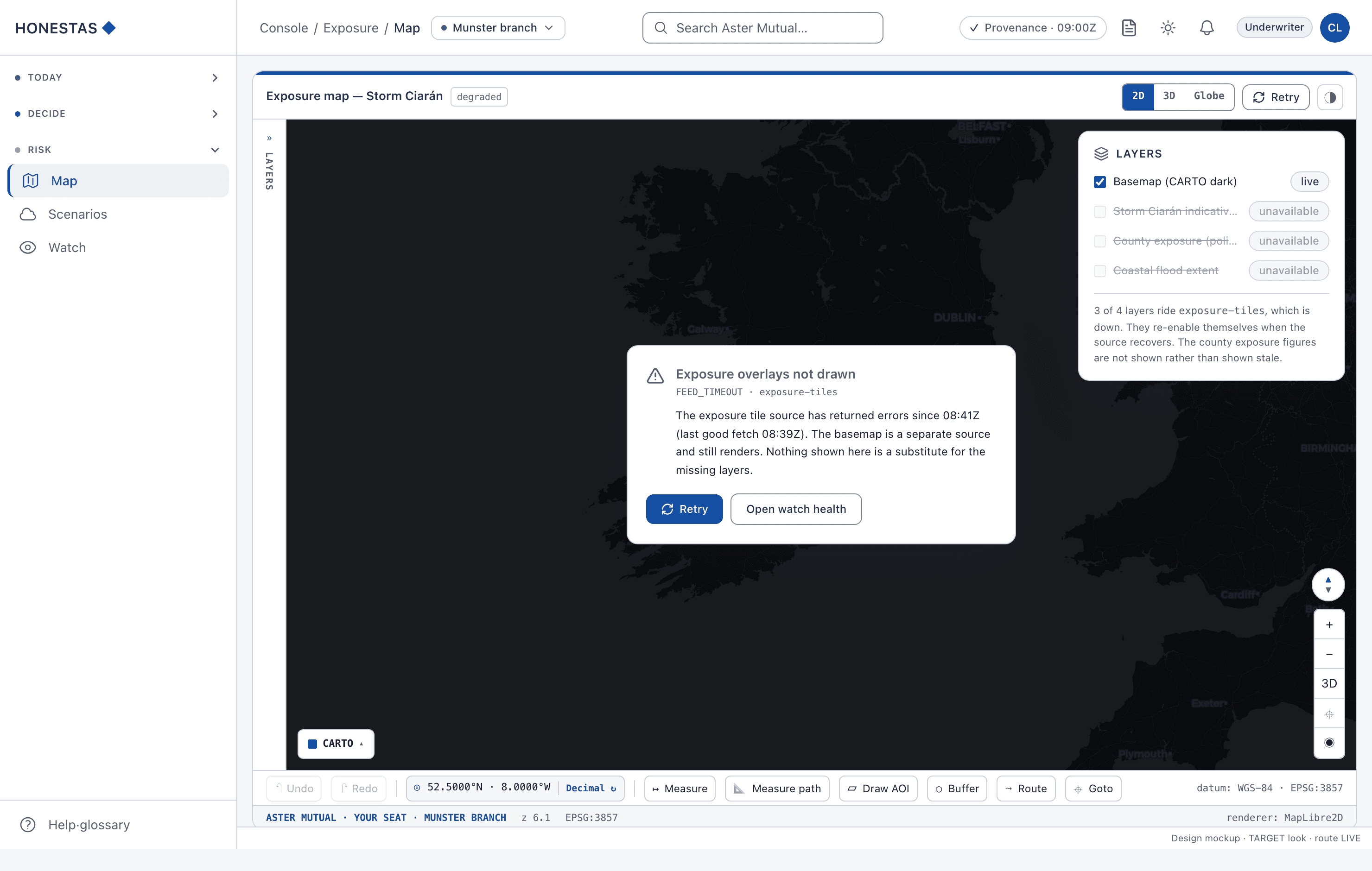 Exposure map — degradedSee it in the gallery →
Plate 02
What we read, and where we read it
Brian reads a field and the page it came from in the same movement, and sends the weak reading to a person.
Every field that enters the record arrives with the document it came from, the page it was on, and how sure the reading was. Where the reading is weak it goes to a person rather than being rounded up.
- declared sum insured · proposal.pdf, page 2 · 0.98
- property count · schedule.xlsx, tab S1 · 0.99
- prior losses, three years · experience.pdf, page 1 · 0.61 ⚠ routed to a person
- Nothing enters the record unattributed. You can open the source at the exact page.
Michael sees in triage — and if something cannot be read, he is told WHICH page, not "please resubmit".
Plate 03
Is it complete, and do we want it
Brian settles completeness and appetite before any work starts, and a decline leaves with its reason attached.
Completeness and appetite are settled before the work starts. A fast decline is a service, not a failure — it comes back with the appetite reason attached.
- accept · decline · refer — argued by seats that do not share an evidence slice, and ruled by a named human
- The appetite reason travels with the answer, so the next submission can be shaped rather than guessed at.
Michael sees declined — and why. A decline that names the appetite reason is worth more to him than a slow maybe.
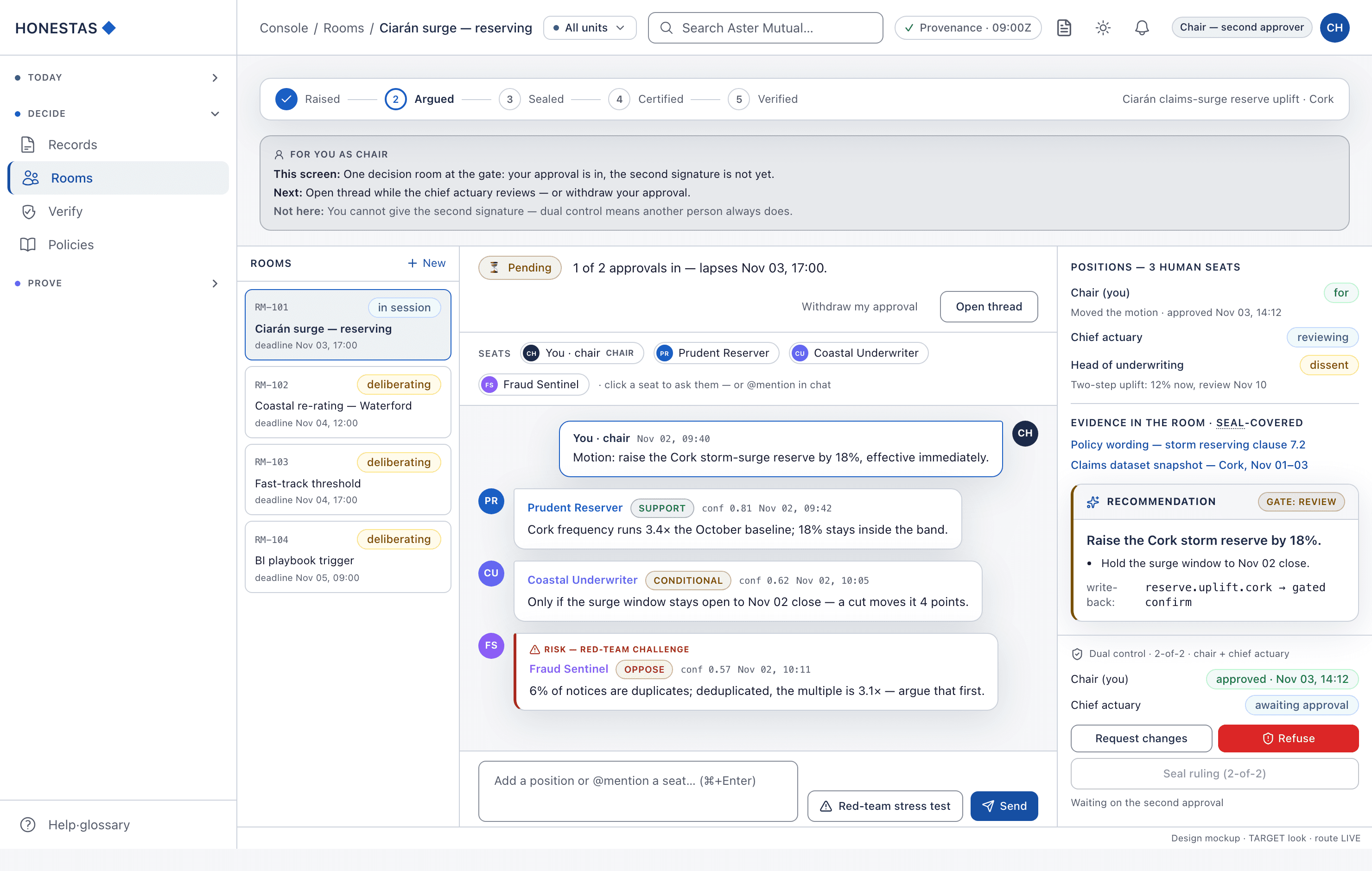 Decision room — in sessionSee it in the gallery →
Plate 04
What we pulled in to help
Brian gets the guidelines and the comparables cited and linked, never recalled at him.
Guidelines, comparable risks, prior submissions and wordings arrive cited and linked back to their source — never presented as something the system remembered.
- guidelines · comparable risks · prior submissions · wordings
- Every external call is logged into the thread with its provenance, so a citation is something you can open rather than something you take on trust.
- Two seats may not argue from the same slice of evidence. Overlapping slices are refused, because agreement between two readers of one document is not corroboration.
Michael sees no action needed.
═ the control layer ═
Plate 05
A control stops it, and says which
Brian is stopped by the control, told which one, and told what would clear it. He cannot wave it away.
Four controls run before anything moves. One of them stops it, names itself, and tells you what would clear it. Nothing moves until it does.
- data quality · passed
- sanctions · passed
- exposure · passed
- completeness · STOPS IT
- It is not a flag you can wave away. The agreement predicate is computed, not learned, and the straight-through lane runs through it too — there is no route around it for the easy ones.
Michael sees one thing needed — a named request with what would clear it, filed against the record. Not a phone call. Not a chase. A thing with a name and a next step.
When it refuses, the refusal has a name: GATE_DISAGREEMENT
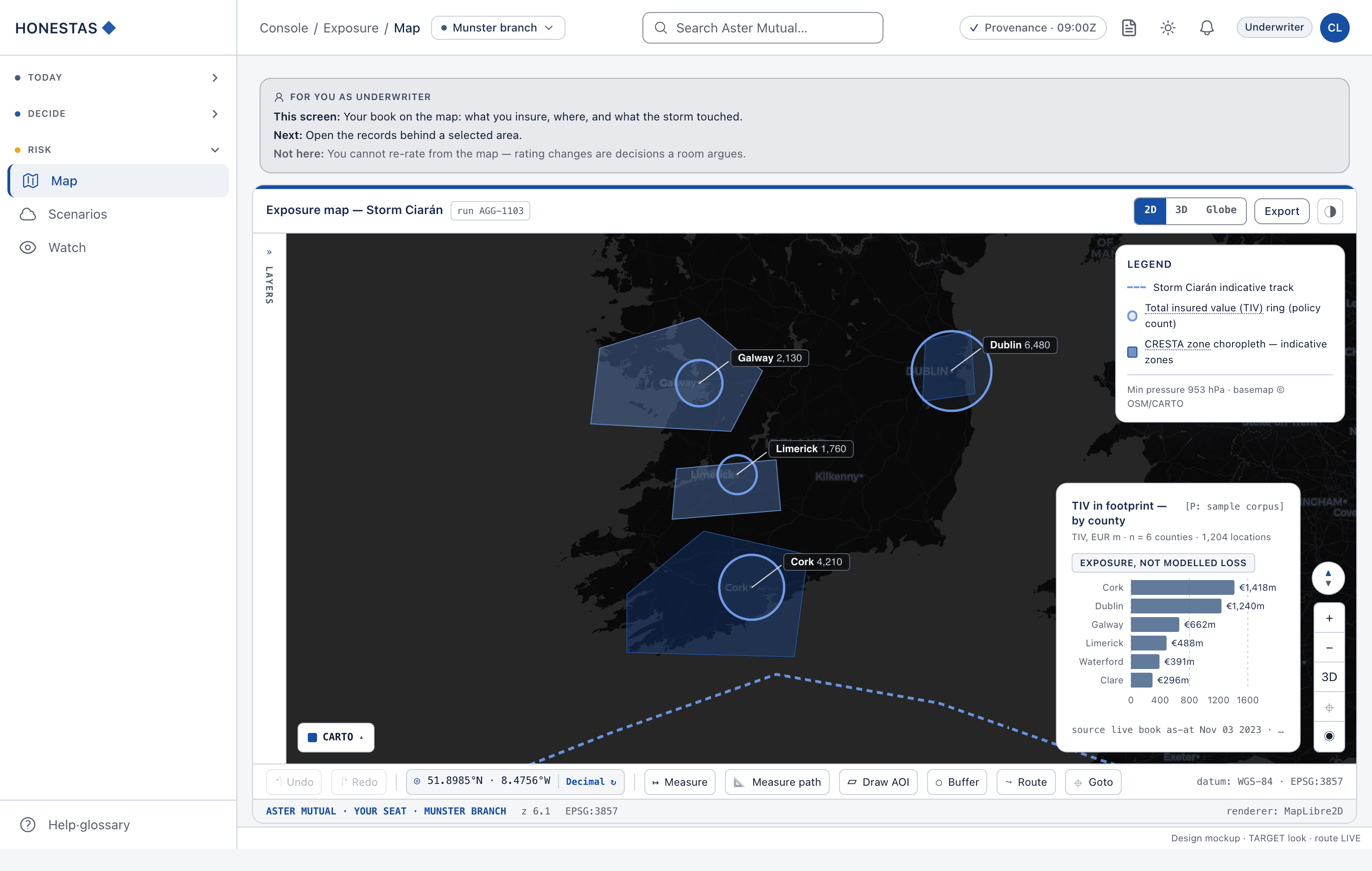 Exposure mapSee it in the gallery →
Plate 06
Brian prices it. We do not.
Brian prices it. He can override anything here, and the override captures his reason.
What was retrieved and what was generated never share a region of the screen — one is cited and linked to its source, the other is marked as written. Brian can override anything here, and the override captures his reason.
- WHAT WE RETRIEVED · cited, linked to source
- WHAT WE WROTE · marked as generated
- These two can never share a region.
- The ruling is captured at a durable waitpoint with its reasons, and the reason becomes a number somebody watches.
Michael sees terms received. What came back is a decision a person owns, not a number a model produced.
Plate 07
Terms issued
Brian issues terms, subjectivities and conditions as one record, and refers what sits outside his authority.
Terms, subjectivities and conditions leave as one record. Where a line sits outside your authority, the referral is a waitpoint with a named approver rather than an email thread.
- terms · subjectivities · conditions
- The corridor carries this into the broker’s own system as a live record — no re-keying.
Michael sees ready to present. No re-keying — the fields are already his.
Decision room — in sessionSee it in the gallery →Plate 08
Bound — and the evidence is already there
Brian binds it with a second named human, and the evidence for it is already assembled.
A second named human arms the bind, and the evidence for it is already assembled, because it assembled while you worked.
- extracted data · with provenance
- retrieved evidence · with citations
- control results · pass · fail · fix
- approvals · who, and when
- overrides · with the reason
- We call this an evidence bundle. That is a courtroom word, not an insurance one — we borrowed it on purpose. It assembles as you work. Nothing is compiled afterwards, because a set of documents assembled after the fact is a reconstruction, and every regulator knows it.
Michael sees bound, with documents — and the customer’s own page goes live the same moment, as a projection of the same log.
═ the control layer ═
Plate 09
It keeps watching after you bind
Brian hears nothing until a number moves, and the numbers include how often he overrides.
Four things are meant to stay under watch after the decision rather than surface at the annual review: how accurately documents are being read, how often controls fail, how often people override, and where referrals cluster.
- extraction accuracy drift
- control failure rates
- how often people override
- referral patterns
- If underwriters keep overriding the same control, the control is wrong or it is being routed around. Either way somebody should know, so it belongs on a board rather than in a habit.
Michael sees silence, unless something needs him — a subjectivity coming due, a renewal window opening.
Your numbers, in your own browser. Nothing is sent anywhere.
Get the free assessment