Line of business · General insurance, or P&C
Your volume lines already run on models. The routing that decided a claim is the part of the file you cannot produce.
A motor claim is scored, a lane is chosen and an outcome is issued before a person reads the file. Six months later a complaint lands, and the reasoning sits in a triage engine, a queue tool and an adjuster’s inbox — three systems that were never asked to agree on what happened.
What breaks in a P&C book today
Triage is a queue, not a decision
The score that sent a claim down the lane where nobody looked at it is a side effect of a job, not a recorded choice. When the complaint arrives, the routing is the part nobody can produce.
The fastest lane has the least oversight
Straight-through processing releases an effect on one model’s answer. Nothing re-derives it, and nothing holds it if the answer is wrong.
Saturation is silent
When the queue cannot meet the deadline, the work does not announce that it is late. It simply becomes late, and the breach surfaces in a complaint rather than on the day.
Explanations are written afterwards
The answer to “why was this denied?” is composed from the outcome, not derived from what the decision actually used. A paraphrase is not an explanation, and it does not survive being checked.
What holds today, and how you check it
How we count this
“Proven live” counts the gate elements we have exercised against the deployed service, not the elements the schema defines. We print the ratio rather than rounding it up.NCT/services/nexus-workflows/src/services/tool-executors/sentinel-executors.tsThe named human is the approval waitpoint in the dispatch spine, not a notification sent after the fact.NX/services/nexus-orchestrator/src/routes/dispatch-routes.tsRegulation (EU) 2024/1689 names insurance risk assessment and pricing in Annex III; Regulation (EU) 2026/1744, the Digital Omnibus on AI, moved when the obligations bite — from 2 August 2026 to 2 December 2027. It is printed as a date rather than a countdown, so it does not decay on this page.Which pillars answer it
P1 · for the Chief Underwriting Officer
Convening Triage + Graduated Escalation
A meta-decision agent scores each submission or claim and convenes the right room, the right chair and the right autonomy tier — and the routing decision is itself a logged event.
The score that chooses the lane, and the autonomy tier it grants, are written down as events — so the routing can be argued about a year later.
NX/services/nexus-orchestrator/src/routes/dispatch-routes.tsP2 · for the Head of Claims
The Chaired Deliberation Chamber
Versioned expert personas argue the case from different angles — including one seat whose only job is to attack the conclusion — and a named human chair rules, at a durable waitpoint.
The contested minority get a room whose seats must argue from different evidence, and a named chair who rules at a durable waitpoint.
PC/src/routes/rooms.routes.tsP3 · for the Chief Risk Officer
Cross-Model Computed Gate → Sealed Certificate
Two or more heterogeneous models re-derive the answer. A computed — not learned — agreement predicate must pass before anything is released, and the inputs and model versions are sealed into the record.
Nothing releases on one model’s word. Two heterogeneous models re-derive the answer and a computed predicate must pass first.
NCT/services/nexus-workflows/src/services/tool-executors/sentinel-executors.tsP5 · for the Chief Compliance Officer
One-Log, Many-Regulator Evidence Fabric
One governed event stream compiles into every regulator’s artefact, instead of four teams reconstructing four different stories from the same week.
The stream that ran the claim is the stream a supervisor reads. You do not rebuild the story; you render the one you already have.
NX/services/nexus-workflows/src/services/governance.tsSee it in the console
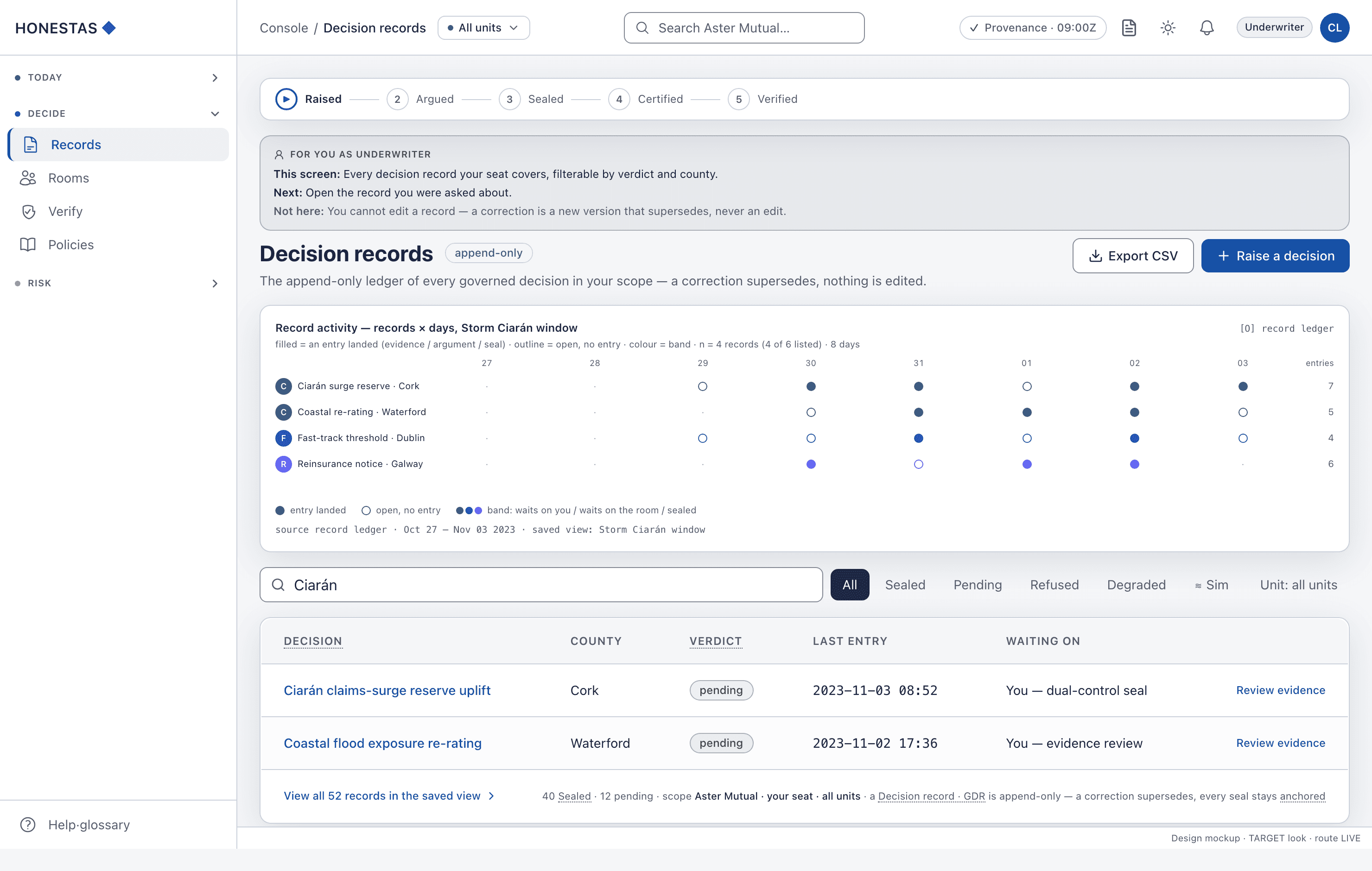
What runs today, in a P&C book
Two dispatch tiers — carrying inline work and callback work — run in production. One governed event stream sits behind the record, so what happened is captured once, at decision time, and read by whoever needs it.
REFUSED
When a queue cannot meet a decision deadline, the work escalates to a human lane and the breach is recorded on the day it happens.
A triage layer that quietly absorbs its own overflow is the one that fails an audit. You would rather read the breach in a log than in a complaint file.
What you can do next
Details for support
DEADLINE_EXCEEDED
Start with one claim type, beside what you run today
You can point the decision seam at a single claim type and run it in parallel with your existing process — no rip-and-replace, and no change to the core system underneath. What you get back is the record of every decision that lane made, in a form you can hand to someone who was not there.