Convening Triage — deciding which decisions need a room, and who should be in it · usually read by the Chief Underwriting Officer
A submission went straight through without a human. Who decided it did not need one, and where is that written down?
Routing is the first decision anyone makes about a case, and in most operations it is the decision nobody keeps. The score that chose the automated lane, the room the case would otherwise have been argued in, the level of autonomy it was granted — all of that happens before the case is ever worked, and by the time an auditor asks, none of it survives.
The routing decision, rendered as the event it already is
- T1InlineA model answers inside the request.
- T2Callback with your recordsWork that needs your data runs against it and calls back.Assigned to this case
- T3AcceleratedSpecialised compute — the same path, a different machine.
- T4Long-runningScenario runs and large ingests: they survive restarts, resume, and can be watched.
- T5VerifiedNothing releases until a second model agrees and the record seals.
- basis
- per-field confidence · coverage, liability and litigation scores · live appetite state
- room
- claims.coverage-committee
- chair
- a named human, assigned at convening time
- scope
- tenant · owner · business unit
- ladder
- tier chosen, and the choice recorded as its own event
- on failure
- the lane degrades to a human queue, loudly — it never drops the case
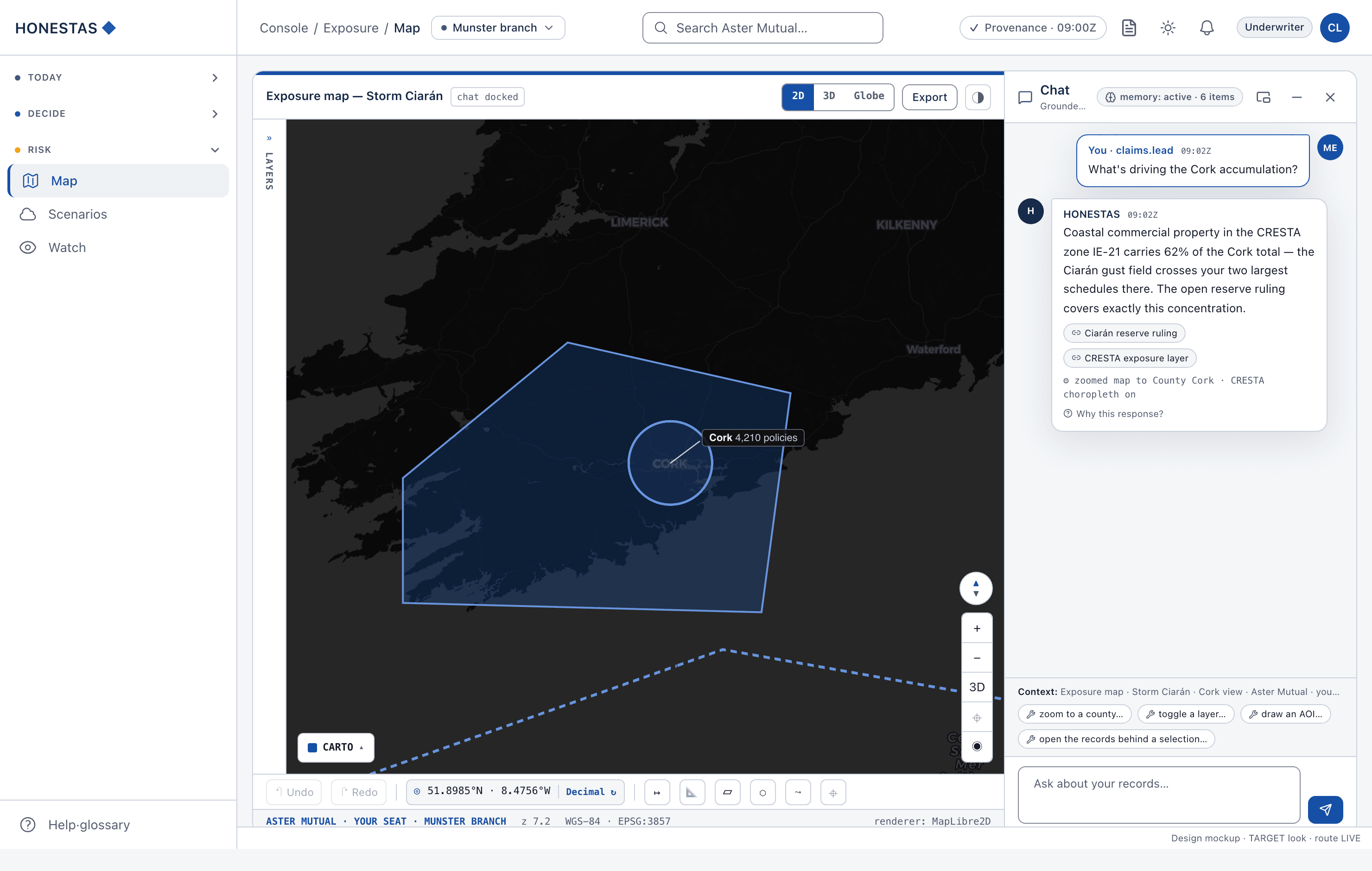
Illustrative composition, built from the components the product ships. No customer data appears anywhere on this site. The dispatch path, the human-approval waitpoint — the pause where work waits for a person — and the interaction log are observed at NX/services/nexus-orchestrator/src/routes/dispatch-routes.ts and NX/services/nexus-workflows/src/services/governance.ts.
See it in the console
The mechanism, in three lines
A meta-decision agent scores each submission or claim and convenes the right room, the right chair and the right autonomy tier — and the routing decision is itself a logged event.
First
It scores before it routes
Per-field confidence on the submission, coverage and liability and litigation scores on the claim, and the live accumulation state of your portfolio are read before any lane is chosen.
Then
It convenes, rather than queues
The room, the seats, the named chair and the autonomy tier are chosen together. A case that needs argument gets a room; a case that does not still passes the gate.
Finally
The routing is an event
The score, the tier, the chair and the reason are written to the same governed thread as the decision they precede — so the question “why did nobody look at this?” has an answer with a timestamp.
observed at NX/services/nexus-orchestrator/src/routes/dispatch-routes.ts
The scoping predicate — the rule that confines every query to its own tenant, owner and unit — lives in the shared query layer every repository inherits, at ROS/src/middleware/organizationContext.ts and NX/services/nexus-auth/internal/authz/openfga_client.go — a surface that cannot resolve all three axes refuses rather than guessing. The two adoption figures come from EIOPA: the generative-AI figure from its survey of 347 undertakings across 25 countries (press release, 2 February 2026, independently reported by DataGuidance), the value-chain figure from the EIOPA digitalisation report (2024), independently reported. Neither is ours, and neither is projected.
Your numbers, in your own browser. Nothing is sent anywhere.
Get the free assessment