Line of business · Brokers, MGAs and coverholders
You bind on someone else’s paper. Whether the risk was inside the pen gets proved afterwards, if at all.
The binder says what you may write. The system says yes. The reconciliation that checks one against the other happens weeks later in a bordereau, which means the control that matters most to your capacity provider runs after the exposure already exists.
What breaks under a delegated authority today
“Inside the pen?” is asked too late
The question that decides whether a bind was authorised is answered in a bordereau weeks afterwards. A breach found then is a conversation with your capacity provider, not a control.
One person can bind alone
Dual control is a line in a procedures manual rather than an arming step in the path. Nothing in the system requires a second named human before the capability can be used.
The pen lives in prose
A binder is a wording that a person interprets, per risk, under time pressure, from memory. Two experienced underwriters can read the same clause differently and both be reasonable.
Your tooling is priced on your book
Licensing metered on premium volume charges you for growth before you have banked it, which is the mechanism that keeps smaller carriers and delegated authorities out of the good tools.
What holds today, and how you check it
How we count this
The metering fact is drawn from incumbent published pricing in our research corpus, which meters on premium volume and on book size. We meter on artefacts instead — a risk bound, a certificate sealed, a seat chaired, a model validated. Growing your book does not grow your bill.Capability arming is in production: a binding is armed by a named administrator before an agent may invoke it, and the arming is revocable and recorded.ROS/src/routes/{skill-bindings,capability-bindings}.tsRegulation (EU) 2024/1689 makes these systems high-risk; Regulation (EU) 2026/1744, the Digital Omnibus on AI, deferred the standalone Annex III obligations from 2 August 2026 to 2 December 2027. A delegated authority writing those risks is inside the same obligation as the carrier whose pen it holds, on the same date.Which pillars answer it
P3 · for the Chief Risk Officer
Cross-Model Computed Gate → Sealed Certificate
Two or more heterogeneous models re-derive the answer. A computed — not learned — agreement predicate must pass before anything is released, and the inputs and model versions are sealed into the record.
Where the formal answer does not reach, two heterogeneous models must re-derive and agree before the bind releases.
NCT/services/nexus-workflows/src/services/tool-executors/sentinel-executors.tsP2 · for the Head of Claims
The Chaired Deliberation Chamber
Versioned expert personas argue the case from different angles — including one seat whose only job is to attack the conclusion — and a named human chair rules, at a durable waitpoint.
A risk that falls outside the pen becomes a referral room with a named chair and a durable waitpoint, rather than an email to the carrier.
PC/src/routes/rooms.routes.tsSee it in the console
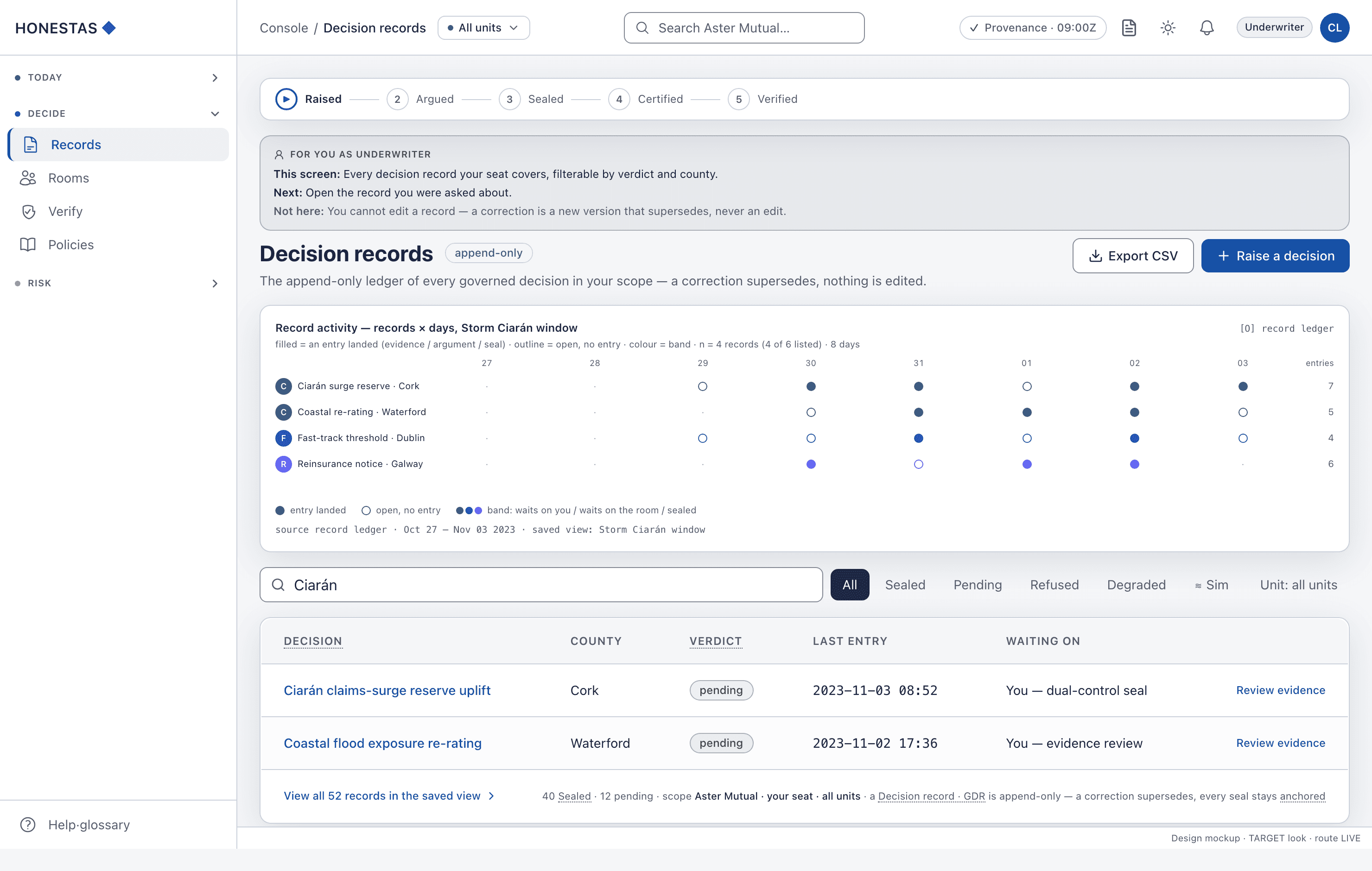
How the pen-boundary answer is checked
The pen-boundary answer runs on two heterogeneous models that independently re-derive it and must agree, with dual-control arming and a referral room when the answer is no. A certificate always names which lane produced the answer, so you always know whether a question was formally proved or cross-checked by models.
REFUSED
A bind outside the pen does not warn and proceed. It refuses, names the clause it failed, and offers the referral room in the same surface.
Every delegated authority already has a rule that says this. The difference is where the rule runs: before the bind arms, in the path, rather than in a reconciliation weeks later where the only remaining option is to report yourself.
What you can do next
Details for support
AUTHORITY_EXCEEDED
Start with one binder
You can encode a single binder, arm one bind capability under dual control, and leave the rest of your placement process untouched. What your capacity provider gets back is a per-risk record of the pen question being asked before the bind, which is the conversation you would otherwise be having at audit.